1
School Buses & Stop Laws
When approaching a school bus that is stopped on the opposite side of a divided highway with flashing red lights in California, you must:
Tap to reveal answer
When approaching a school bus that is stopped on the opposite side of a divided highway with flashing red lights in California, you must:
Tap to reveal answer
Under California Vehicle Code §22454(b), drivers traveling in the opposite direction on a divided highway — where a median or physical barrier separates lanes — are not required to stop for a school bus with flashing red lights. On any two-lane or undivided road, you must stop from either direction.
2
Phones & Distracted Driving
Under California law, when is it legal for an adult driver (18+) to hold and use a cell phone while behind the wheel?
Tap to reveal answer
Under California law, when is it legal for an adult driver (18+) to hold and use a cell phone while behind the wheel?
Tap to reveal answer
California Vehicle Code §23123.5 requires hands-free operation for all adult drivers. The phone must be mounted (dashboard, windshield, or center console) and may only be activated with a single tap or swipe of the finger. Drivers under 18 cannot use any phone — hands-free or not.
3
Alcohol, Drugs & DUI
What is the legal blood alcohol concentration (BAC) limit for drivers under 21 in California?
Tap to reveal answer
What is the legal blood alcohol concentration (BAC) limit for drivers under 21 in California?
Tap to reveal answer
California enforces a zero-tolerance policy for drivers under 21: any BAC of 0.01% or higher results in a one-year license suspension. For drivers 21 and older, the standard limit is 0.08%. For commercial drivers, it drops to 0.04%.
4
Speed Limits & Stopping Distance
Under California's Basic Speed Law, the maximum legal speed is:
Tap to reveal answer
Under California's Basic Speed Law, the maximum legal speed is:
Tap to reveal answer
California's Basic Speed Law (CVC §22350) states that no one may drive faster than is safe for current conditions — weather, traffic, visibility — regardless of the posted limit. 55 mph in heavy fog may still be illegal even though the sign says 65. The posted limit is always the upper ceiling, never a guaranteed safe speed.
5
Bicycles, Motorcycles & Pedestrians
When passing a bicyclist on a California road, the driver must provide a minimum clearance of:
Tap to reveal answer
When passing a bicyclist on a California road, the driver must provide a minimum clearance of:
Tap to reveal answer
California's Three Feet for Safety Act (CVC §21760) requires motor vehicles passing a bicyclist in the same direction to leave at least 3 feet of clearance between the vehicle and the cyclist. If 3 feet isn't available, the driver must slow to a safe speed and only pass when safe.
6
Alcohol, Drugs & DUI
For a first-offense standard DUI in California (BAC 0.08%+, no injury), typical penalties include:
Tap to reveal answer
For a first-offense standard DUI in California (BAC 0.08%+, no injury), typical penalties include:
Tap to reveal answer
A first-offense DUI in California (BAC ≥0.08% for adults) typically results in fines of $390–$1,000 (plus thousands in penalty assessments), 6-month license suspension, completion of a 3-month DUI program, up to 6 months in jail, and 3–5 years of probation. Penalties escalate sharply with repeat offenses or injury.
7
Right of Way & Turn Rules
At a California 4-way stop where two vehicles arrive simultaneously, who has the right of way?
Tap to reveal answer
At a California 4-way stop where two vehicles arrive simultaneously, who has the right of way?
Tap to reveal answer
At a 4-way stop, the first vehicle to fully stop has priority. If two vehicles arrive at the same time, the vehicle on the right has right of way. If two vehicles face each other, the one going straight or turning right has priority over one turning left.
8
Parking, Stopping & Standing
In California, how close to a fire hydrant may you legally park?
Tap to reveal answer
In California, how close to a fire hydrant may you legally park?
Tap to reveal answer
California Vehicle Code §22514 prohibits parking within 15 feet of a fire hydrant unless an attended vehicle. Fire departments need clear access for hose connections in emergencies. Violations result in parking tickets and possible towing, especially if the hydrant is needed.
9
Signs & Signals
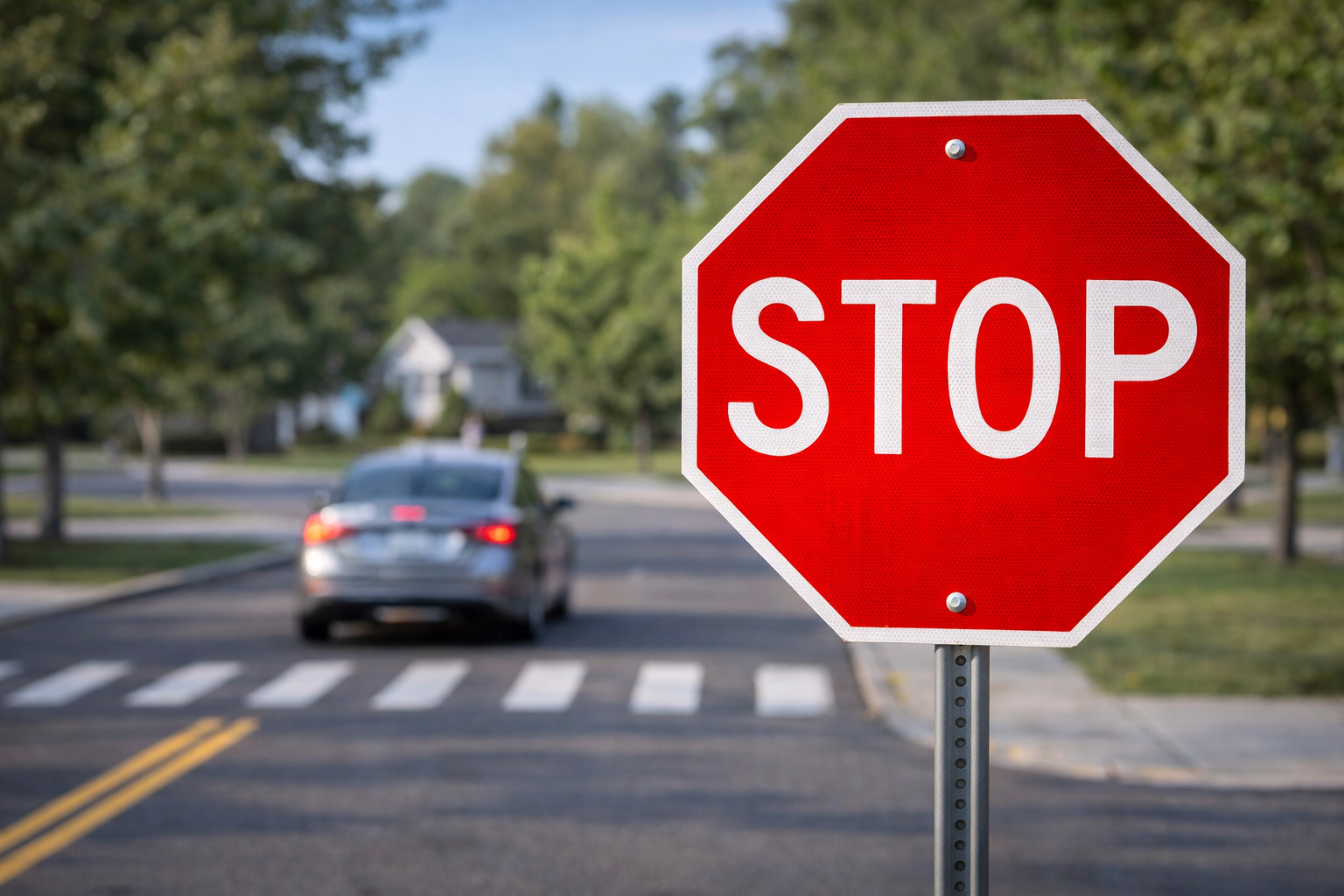
What does this sign indicate?
Tap to reveal answer
What does this sign indicate?
Tap to reveal answer
A stop sign means you must come to a complete stop and proceed only when it is safe.
10
Signs & Signals
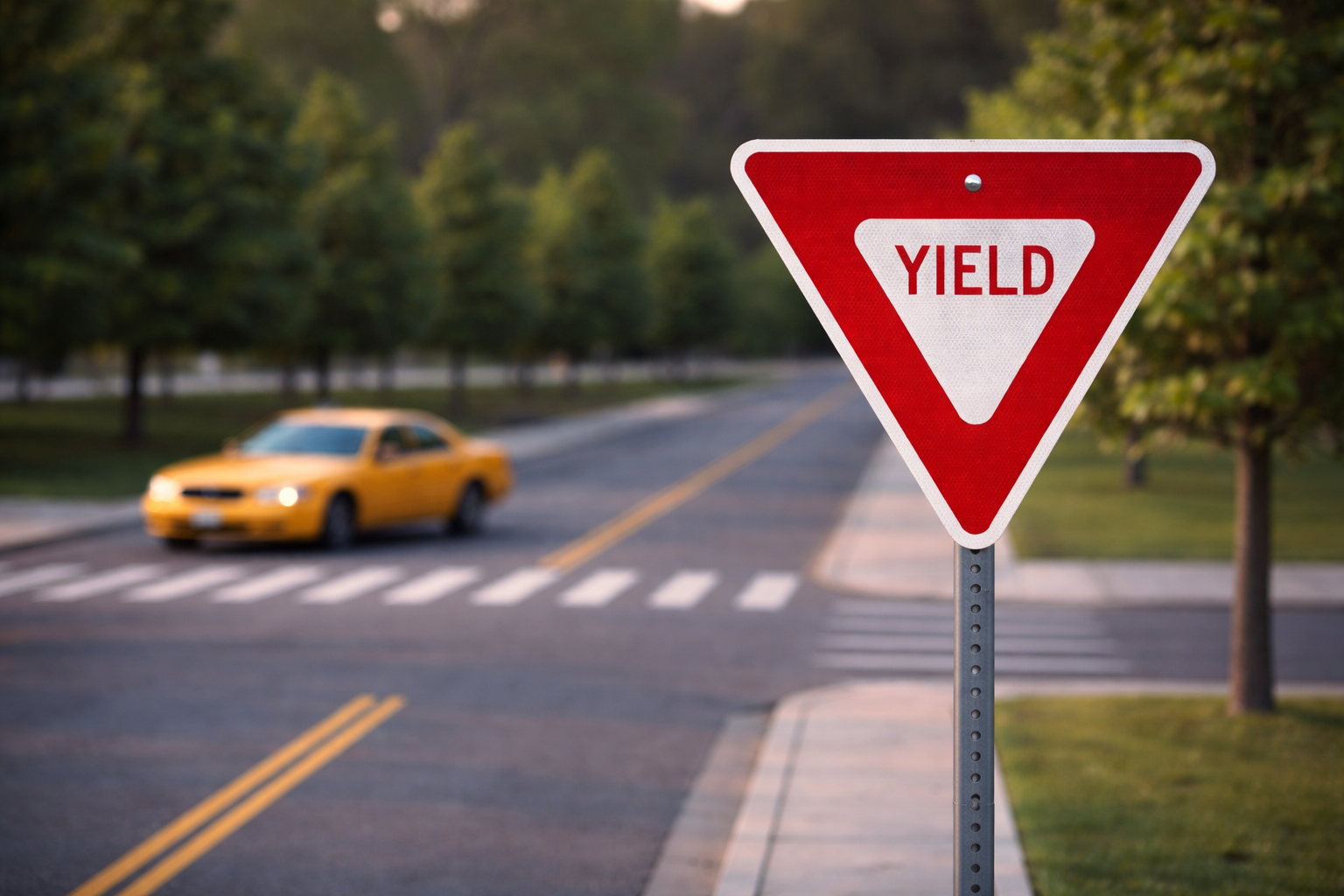
What does this sign indicate?
Tap to reveal answer
What does this sign indicate?
Tap to reveal answer
A yield sign means slow down, give the right-of-way when required, and stop if necessary.
Get the full California practice in our app
Hundreds of California questions, timed mock exams matching the real DMV test, progress tracking, and offline mode — all free.
Back to California overview
Test facts, passing score, specialty laws
Browse all California questions
10 indexed question pages with explanations